Benchmarks and studies let you choose tools on evidence instead of vendor claims. In an AI video editing workflow they matter most for captions and transcription, for render cost, and for research on agent-assisted editing. Every entry here links to its source. We read the source and the licence, but we did not test the items, and any licence trap is shown on the card. When we judge an entry we ask who ran the test, whether the method is open, and whether the audio or footage looks like what editors actually work with. Watch for vendor-run comparisons, live pages whose numbers change, and older studies that predate current models. Check the live source before you quote any score.
Open ASR Leaderboard (Hugging Face Space): A public ranking of speech recognition models with open code behind it. Limit: It is a live page, so scores must be checked before quoting.
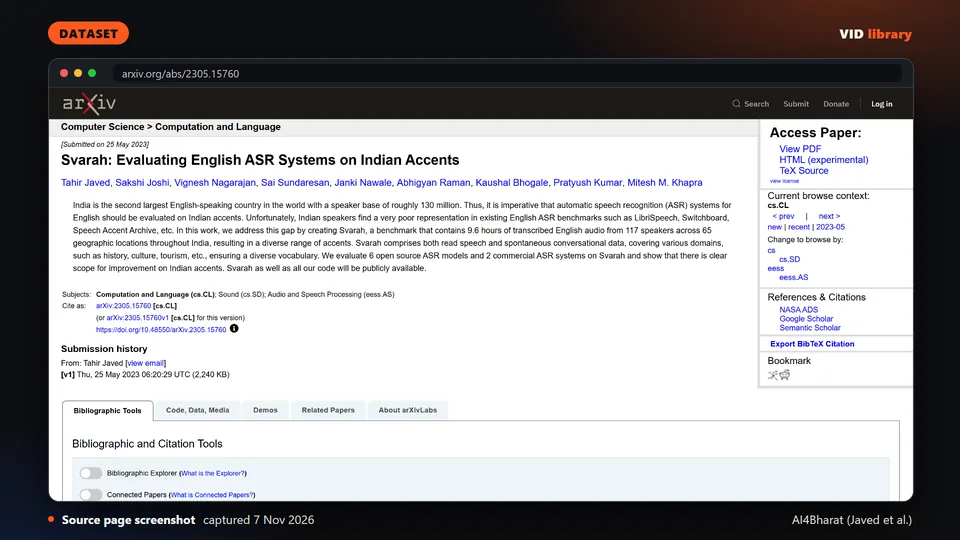
Svarah: English ASR on Indian accents: It tests recognisers on Indian-accented English, where mainstream benchmarks say little. Limit: The abstract page gave no numbers, so the paper tables must be read.
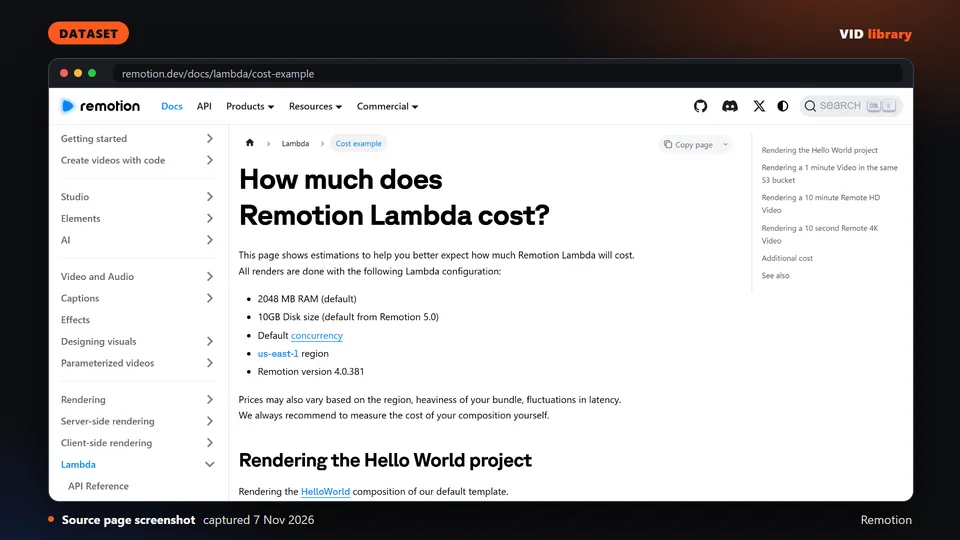
Remotion Lambda cost example: Official worked examples give concrete render time and cost on Remotion Lambda for budgeting. Limit: These are vendor numbers on its own platform and cover compute only.
Public ranking of speech recognition models by error rate and speed, with open code behind it. The catch is that it is a live page, so check the table before quoting any score.
Use it for: Compare caption transcription models by accuracy and speed.
Licence, price and checks
Licence unclear
Reuse a paper or leaderboard we read and cite; we reuse nothing from it.
Library check works, Oct 17, 2026
Source reviewed on Oct 17, 2026. Not tested by us.
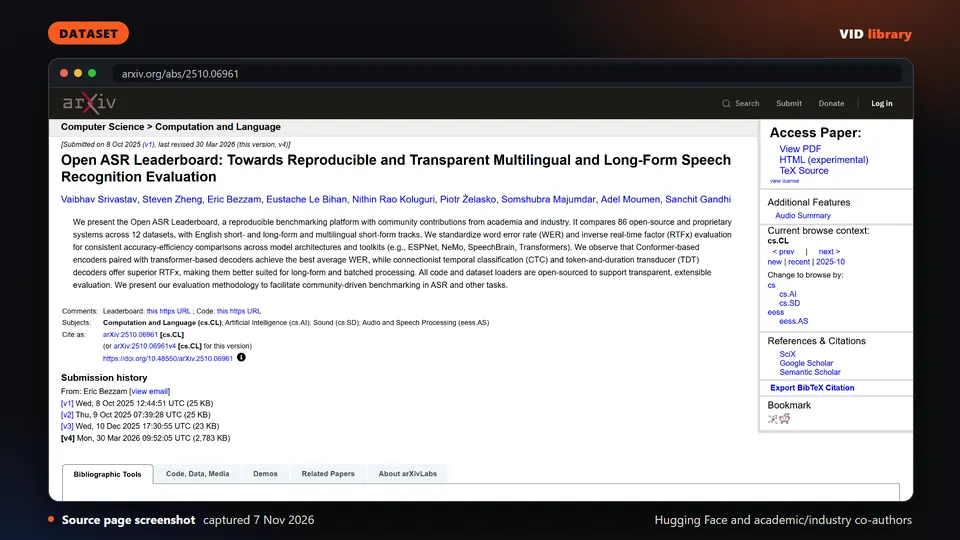
The paper that explains how the Open ASR Leaderboard compares systems, so the method can be cited. The catch is that scores change between versions and the multilingual track covers European languages, with no Hindi seen.
Use it for: Cite the method behind a standard transcription comparison.
Licence, price and checks
Licence unclear
Reuse a paper or leaderboard we read and cite; we reuse nothing from it.
Library check works, Oct 17, 2026
Source reviewed on Oct 17, 2026. Not tested by us.
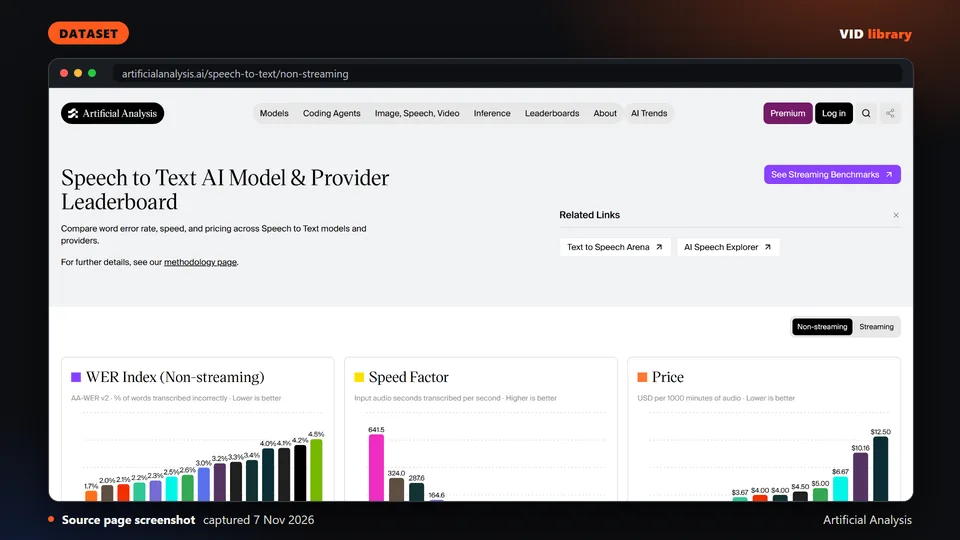
Independent ranking of hosted transcription services showing accuracy, speed and price together. The catch is that its test audio is not noisy creator footage, rankings shift often, and the page shows no publication date.
Use it for: Weigh accuracy, speed and price for a captioning API.
Licence, price and checks
Licence proprietary
Reuse a paper or leaderboard we read and cite; we reuse nothing from it.
Library check works, Oct 17, 2026
Source reviewed on Oct 17, 2026. Not tested by us.
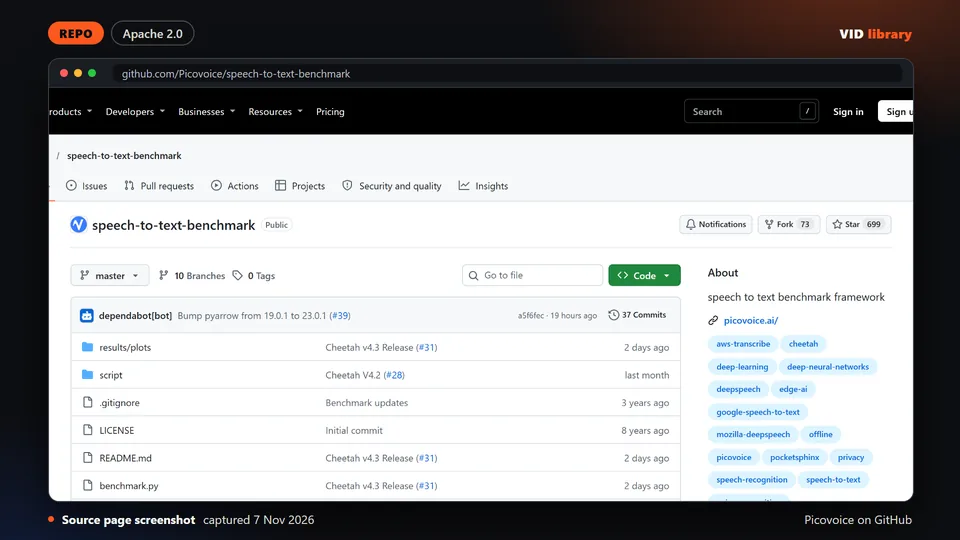
Open framework for rerunning speech-to-text comparisons on your own audio, with compute cost measures. Apache-2.0, last pushed 2026-11-05. The catch is that Picovoice includes its own engines, and its data is read speech and TED talks.
Use it for: Rerun a transcription comparison on your own talking-head audio.
Licence, price and checks
Licence Apache-2.0
Reuse keep the licence notice
Library check works, Oct 10, 2026
Source reviewed on Oct 10, 2026. Not tested by us.
Evidence on how speech recognisers handle Indian-accented English, where mainstream benchmarks say little. The catch is that the abstract gave no numbers or system names, so read the paper tables first, and it dates from 2023.
Use it for: Judge caption accuracy for Indian-accented English.
Licence, price and checks
Licence unclear
Reuse a paper or leaderboard we read and cite; we reuse nothing from it.
Library check works, Oct 10, 2026
Source reviewed on Oct 10, 2026. Not tested by us.
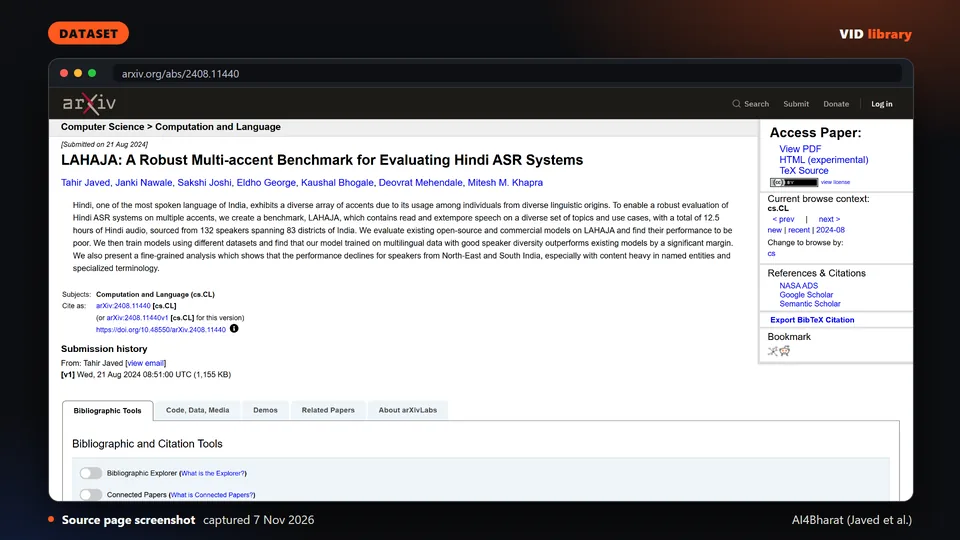
Hindi recognition test set built across regional accents and speech styles. The catch is that the abstract page lists no per-system error rates, so read the paper before quoting, and no Whisper result was seen.
Use it for: See where Hindi captioning degrades across accents.
Licence, price and checks
Licence unclear
Reuse a paper or leaderboard we read and cite; we reuse nothing from it.
Library check works, Oct 10, 2026
Source reviewed on Oct 10, 2026. Not tested by us.
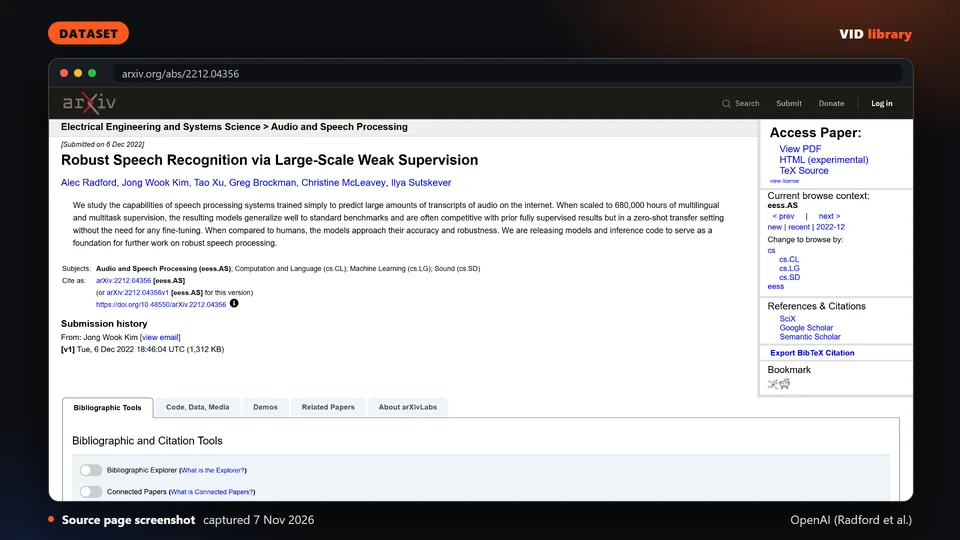
The original Whisper paper, the primary source for what the model was trained and scored on. The catch is that it is a 2022 vendor paper and does not cover later large variants.
Use it for: Learn what Whisper was and was not tested on.
Licence, price and checks
Licence unclear
Reuse a paper or leaderboard we read and cite; we reuse nothing from it.
Library check works, Oct 10, 2026
Source reviewed on Oct 10, 2026. Not tested by us.
Official worked examples of render time and cost on Remotion Lambda, handy for budgeting. The catch is that these are vendor numbers on its own platform, cover compute only, show no date, and Remotion's licence needs checking.
Use it for: Estimate render time and cost for programmatic video.
Licence, price and checks
Licence proprietary
Reuse a paper or leaderboard we read and cite; we reuse nothing from it.
Library check works, Oct 10, 2026
Source reviewed on Oct 10, 2026. Not tested by us.
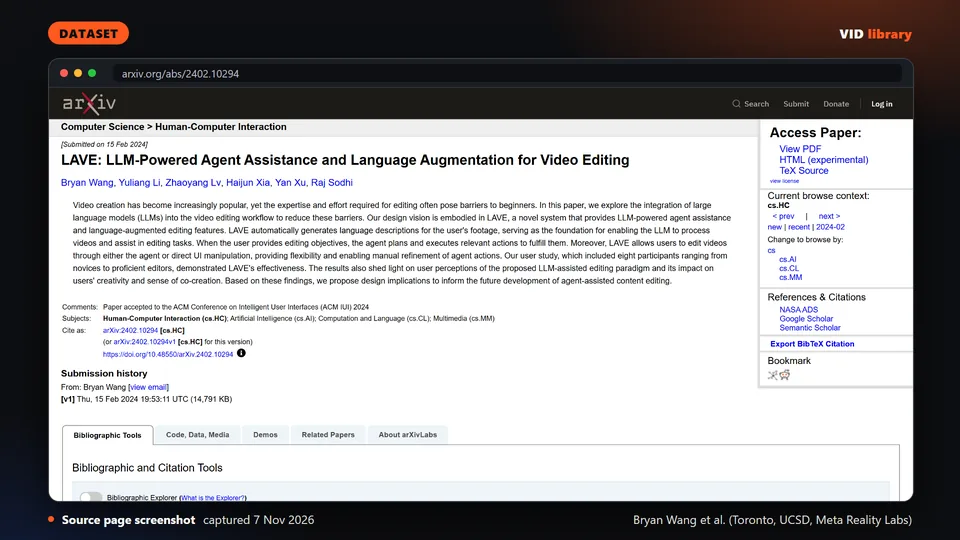
By Bryan Wang et al. (Toronto, UCSD, Meta Reality Labs)
Academic baseline for an LLM agent that edits video from text descriptions of footage. The catch is that no public code was found, the study is small, and it predates current coding agents.
Use it for: Get an academic baseline for agent-assisted editing.
Licence, price and checks
Licence unclear
Reuse a paper or leaderboard we read and cite; we reuse nothing from it.
Library check works, Oct 10, 2026
Source reviewed on Oct 10, 2026. Not tested by us.
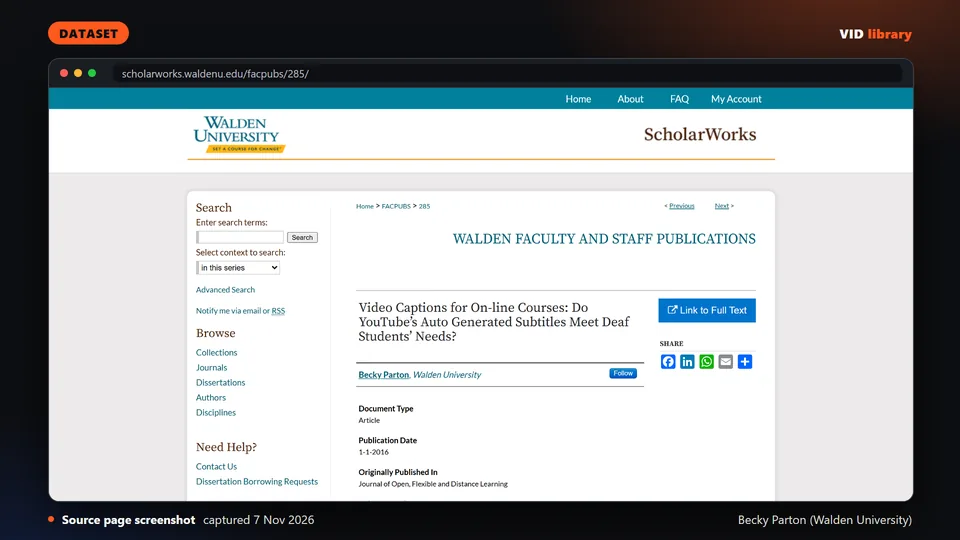
Small 2016 study showing auto-captions fell short for deaf students. The catch is that it used an older engine, a tiny sample and phrase-level errors rather than WER, so treat it as history.
Use it for: Contrast early auto-caption accuracy with current tools.
Licence, price and checks
Licence unclear
Reuse a paper or leaderboard we read and cite; we reuse nothing from it.
Library check likely works, Oct 10, 2026
Source reviewed on Oct 10, 2026. Not tested by us.
How we review resources
Every entry is a third-party item that we read, not one we ran. Before a card is published, we check that the source page is live, that our description matches it, and that the licence on the card matches the licence at the source. The card says when we checked and that we did not test the item.
Held back, not shown: items whose licence is unclear for anything you would reuse, items with a non-commercial licence, and items that need your login cookies, run unreviewed install scripts or send data off your device without saying so.
Links only: articles, changelogs, videos and docs that you read but do not copy need no reuse licence, and the card says so.
Licence traps are shown on the card, not hidden: copyleft code (GPL, AGPL) you should link to but never bundle, non-commercial terms and mixed per-file licences.
No star counts, follower counts or growth figures. A count of what a page lists carries the date we counted.
A card with a source link that stops working is retired. Gated items (an account, email sign-up or paid plan behind a free label) say so in the catch.