Effect #068 in our rendered series
Chromatic wipe transition
A fast slide wipe splits into red and blue channels on its peak frames and reveals scene B.
Rendered by us at 1920x1080 over shots from Tears of Steel (Blender Foundation, CC-BY 3.0). Expand plays the full 1080p file.
Edit in Premiere, Resolve or After Effects? Jump to editor templates. Making many versions of the same video? Use the code route.
Make this effect with
Built and tested by us
Other ways, not tested by us
Use it in a real edit
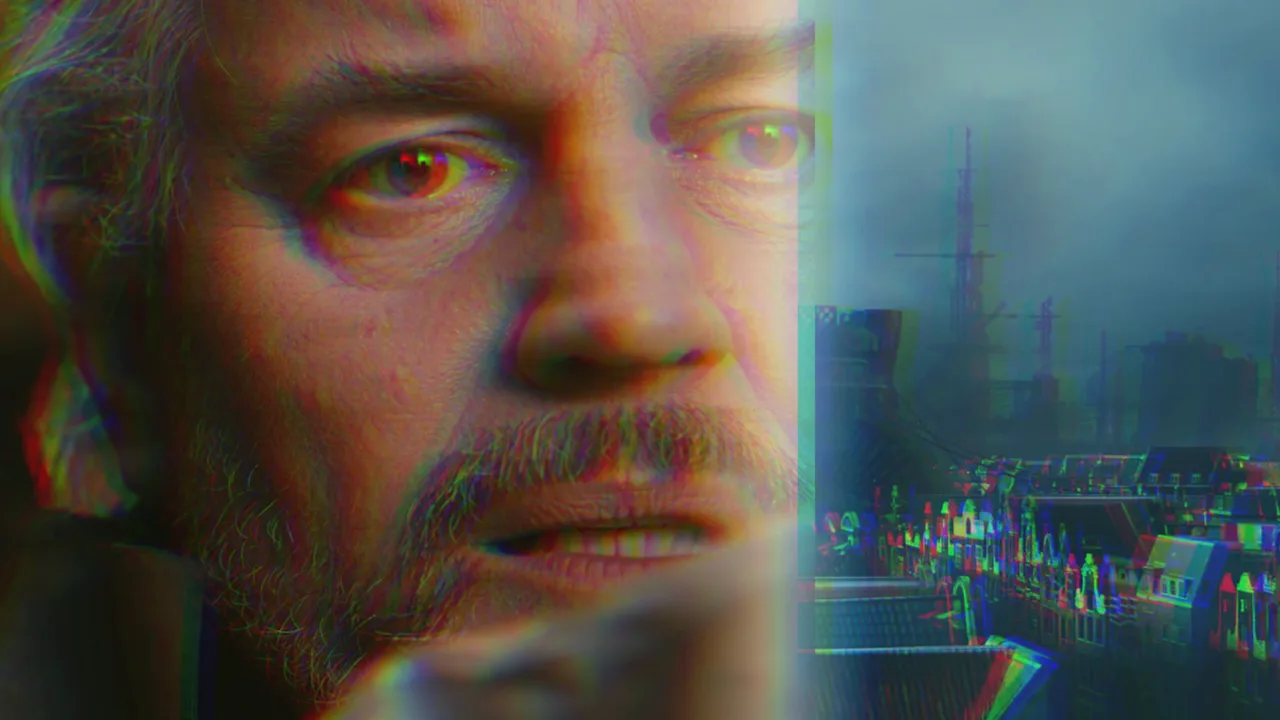
The same chromatic wipe from Old Thom to the skyline. Nothing in the composition changed except the footage file.
The composition plays your clip as a muted <video> layer under the graphics (the file plate.mp4 in the code below), so you swap the footage by replacing that file and rendering again. To use the graphics in an editor instead, switch the background off and render a transparent MOV (an H.264 MP4 cannot carry transparency):
npx hyperframes render . -o overlay.mov --format mov --fps 24 --variables '{"plate":false}'The routes in full
With Claude Code: the prompt we used
Rendered and tested by us in HyperFrames 0.8.10 on Nov 7, 2026.
Make a 5 second transition where a fast slide wipe splits into red and blue channels on its peak frames and reveals scene B over scene A, with the direction and the split strength as variables. Keep any flash soft and short.
What changed since this prompt: the demo on this page is our second version, 5 seconds long, rebuilt on 2 shots from Tears of Steel with the same animation idea. The full composition below is the one we rendered; its build log lists every change.
Built by a Claude Code subagent (Sonnet) from the HyperFrames registry component chromatic-aberration-wipe, HyperFrames 0.8.10. Claude Code then checked the composition with hyperframes lint and hyperframes check before we rendered it.
What we had to correct (11 notes from the build log):
- 6 Nov 2026, lint 1: 1 error, `invalid_composition_variables_declaration` (the variables JSON was written HTML-escaped inside a double-quoted attribute, and the linter does not decode entities). Fix: the attribute is now single-quoted raw JSON.
- 6 Nov 2026, lint 2: 0 errors, 0 warnings.
- Adapted from chromatic-aberration-wipe: kept the clip-path wipe edge, the slide of both scenes and the soft sheen. Replaced the red/cyan gradient overlay with a real channel split (SVG filter: red and blue copies offset along the wipe direction, switched on only on the fast middle frames). The sheen is now a narrow translucent strip riding the edge, not a full-frame sweep. A second wipe returns to scene A so the loop is clean.
- Decided against: the accent variable (the brief asks for direction and split strength only).
- hyperframes check: "Check failed", 4 errors, by design for a wipe where scene B covers scene A. Quoted: "t=1.63-3.5s (18 samples) content_overlap #alab inside #blab "Scene A" - Two text blocks overlap and may render unreadable" and "t=1.94-3.06s (3 samples) text_occluded #alab inside div.sbg.bbg "Scene A" - Text is hidden beneath an opaque element" (and the same for #asub). Scene A is under scene B until the wipe passes. By eye (1.3 to 3.6 s) the two scenes never mix sharp text; the RGB split only shows on the fast frames.
- Render: flash check passed. Known small flaw: on the peak frames a 3 px dark strip shows at the frame edge where the split filter samples outside the picture. Left as is, noted.
- Cause of the dark strip at the frame edge on peak frames: the red and blue copies are shifted sideways by the channel split, and at the frame edge they sampled outside the picture, so one channel was missing there.
- Fix: both scenes now live in an overscan layer (#fx) that is 80 px larger than the frame on every side (the split is at most 52 px at strength 2). Scene backgrounds and the clip path reach 80 px beyond the frame on every side except the moving wipe edge. The frame still clips it, so nothing outside the picture is ever shown.
- Marked #fx data-layout-allow-overflow because the overscan is intentional; this removed the new container_overflow warning. lint: 0 errors, 0 warnings. check: the same 4 by-design content_overlap and text_occluded flags quoted above (scene A under scene B), 0 motion errors, 10/10 contrast checks pass.
- Re-render: flash check passed. Measured the 3 leftmost and rightmost columns and the 4 top and bottom rows at the peak frames (1.5 s, 1.62 s, 3.5 s; default, up and down variations): luminance changes smoothly (for example 74.9 to 76.6 across the left edge at 1.5 s), with no step. Looked at the 1920 px frames at 1.62 s and 3.5 s by eye: no strip, the split shows only as red and blue fringes on text and shapes.
- v2 (7 Nov 2026): real footage from Tears of Steel, plates tr_brain, tr_street. One wipe 0.7 s at 2.0 s (the v1 second wipe back to A was removed).
With HyperFrames code
Rendered and tested by us in HyperFrames 0.8.10 on Nov 7, 2026.
npx hyperframes add chromatic-aberration-wipe
npx hyperframes render . -o out.mp4 --fps 24
Settings you can change without rebuilding (pass them with --variables):
| Setting | Name | Type | Default |
|---|---|---|---|
| Wipe direction | direction | enum | left |
| Channel split strength | strength | number | 1 |
| Show background | plate | boolean | true |
Our full composition (index.html, 8 KB)
<!doctype html>
<html lang="en" data-composition-variables='[{"id":"direction","type":"enum","label":"Wipe direction","default":"left","options":[{"value":"left","label":"Left"},{"value":"right","label":"Right"},{"value":"up","label":"Up"},{"value":"down","label":"Down"}]},{"id":"strength","type":"number","label":"Channel split strength","default":1,"min":0,"max":2,"step":0.1},{"id":"plate","type":"boolean","label":"Show background","default":true}]'>
  <head>
    <meta charset="UTF-8" />
    <meta name="viewport" content="width=1920, height=1080" />
    <link href="https://fonts.googleapis.com/css2?family=Montserrat:wght@800&display=block" rel="stylesheet" />
    <script src="gsap.min.js"></script>
    <style>
      *, *::before, *::after { box-sizing: border-box; margin: 0; padding: 0; }
      html, body { width: 1920px; height: 1080px; overflow: hidden; background: transparent; }
      #root { position: relative; width: 100%; height: 100%; overflow: hidden; background: transparent; }
      #stage { position: absolute; inset: 0; overflow: hidden; }
      #fx { position: absolute; left: -80px; top: -80px; width: 2080px; height: 1240px; }
      .scene { position: absolute; left: 80px; top: 80px; width: 1920px; height: 1080px; font-family: "Montserrat", sans-serif; font-weight: 800; }
      .vid { position: absolute; left:-80px; top:-80px; width:2080px; height:1240px; object-fit: cover; }
      #B { clip-path: inset(0 0 0 100%); }
      #glow { position: absolute; left: 0; top: 0; opacity: 0; pointer-events: none; z-index: 5; }
      #svgdefs { position: absolute; width: 0; height: 0; }

    </style>
  </head>
  <body>
    <div id="root" data-composition-id="main" data-start="0" data-duration="5" data-fps="24" data-width="1920" data-height="1080">
      <svg id="svgdefs" xmlns="http://www.w3.org/2000/svg" width="0" height="0"><defs>
        <filter id="ca" x="0" y="0" width="100%" height="100%" color-interpolation-filters="sRGB">
          <feColorMatrix in="SourceGraphic" type="matrix" values="1 0 0 0 0  0 0 0 0 0  0 0 0 0 0  0 0 0 1 0" result="r" />
          <feOffset id="ro" in="r" dx="0" dy="0" result="rs" />
          <feColorMatrix in="SourceGraphic" type="matrix" values="0 0 0 0 0  0 1 0 0 0  0 0 0 0 0  0 0 0 1 0" result="g" />
          <feColorMatrix in="SourceGraphic" type="matrix" values="0 0 0 0 0  0 0 0 0 0  0 0 1 0 0  0 0 0 1 0" result="b" />
          <feOffset id="bo" in="b" dx="0" dy="0" result="bs" />
          <feBlend in="rs" in2="g" mode="screen" result="rg" />
          <feBlend in="rg" in2="bs" mode="screen" />
        </filter></defs></svg>
      <div id="stage">
        <div id="fx" data-layout-allow-overflow><div class="scene" id="A"><video class="plate vid" src="plate_a.mp4" muted playsinline data-start="0" data-duration="2.9"></video></div>
        <div class="scene" id="B"><video class="plate vid" src="plate_b.mp4" muted playsinline data-start="2.0" data-duration="3.0"></video></div>
        <div id="glow"></div></div>
      </div>
    </div>
    <script>
      window.__timelines = window.__timelines || {};
      (function () {
        const v = window.__hyperframes.getVariables();
        const tl = gsap.timeline({ paused: true });

        if (!v.plate) document.querySelectorAll(".plate").forEach((e) => (e.style.display = "none"));
        const W = 1920, H = 1080;
        const DIRS = { left: [-1, 0], right: [1, 0], up: [0, -1], down: [0, 1] };
        if (!DIRS[v.direction]) v.direction = "left";
        const dir = DIRS[v.direction];
        const dx = dir[0], dy = dir[1];
        const STR = Math.max(0, Math.min(2, isFinite(Number(v.strength)) ? Number(v.strength) : 1));
        const T1 = 2.0, T2 = 99, D = 0.7, PAR = 90;
        const ease = gsap.parseEase("power4.inOut");
        const A = document.getElementById("A"), B = document.getElementById("B"), stage = document.getElementById("fx");
        const OS = 80; // overscan: the colour split samples from this margin, so no dark strip reaches the frame edge
        const glow = document.getElementById("glow"), ro = document.getElementById("ro"), bo = document.getElementById("bo");
        const horiz = dx !== 0;
        // soft edge glow: a narrow translucent strip that rides the wipe edge
        const GL = 280;
        glow.style.width = (horiz ? GL : W + 2 * OS) + "px"; glow.style.height = (horiz ? H + 2 * OS : GL) + "px";
        glow.style.background = "linear-gradient(" + (horiz ? "90deg" : "180deg") + ", rgba(255,255,255,0), rgba(255,255,255,0.5), rgba(255,255,255,0))";
        function clipFor(q, second) {
          // pixel insets; every side that is not the wipe edge reaches OS px beyond the frame (the overscan).
          // The wipe edge side also reaches the overscan when scene B fully covers the frame.
          const O = -OS, dim = horiz ? W : H;
          const val = second ? (q <= 0 ? O : q * dim) : (q >= 1 ? O : (1 - q) * dim);
          let t = O, r = O, b = O, l = O;
          if (!second) {
            if (v.direction === "right") r = val; else if (v.direction === "up") t = val; else if (v.direction === "down") b = val; else l = val;
          } else {
            if (v.direction === "right") l = val; else if (v.direction === "up") b = val; else if (v.direction === "down") t = val; else r = val;
          }
          return "inset(" + t.toFixed(1) + "px " + r.toFixed(1) + "px " + b.toFixed(1) + "px " + l.toFixed(1) + "px)";
        }
        function edgePos(q) {
          if (v.direction === "right") return W * q + OS;
          if (v.direction === "up") return H * (1 - q) + OS;
          if (v.direction === "down") return H * q + OS;
          return W * (1 - q) + OS;
        }
        const st = { t: 0 };
        function paint() {
          const t = st.t;
          const u1 = Math.max(0, Math.min(1, (t - T1) / D)), u2 = Math.max(0, Math.min(1, (t - T2) / D));
          const q1 = ease(u1), q2 = ease(u2);
          const second = t >= T2;
          const q = second ? q2 : q1, u = second ? u2 : u1;
          B.style.clipPath = t < T1 ? clipFor(0, false) : (second ? clipFor(q2, true) : clipFor(q1, false));
          // slide: scene B drifts in, scene A is pushed along under it (and back again on the second wipe)
          let bOff, aOff;
          if (!second) { bOff = (1 - q1) * -PAR; aOff = q1 * PAR; } else { bOff = q2 * PAR; aOff = (1 - q2) * -PAR; }
          B.style.transform = "translate(" + (dx * bOff).toFixed(1) + "px," + (dy * bOff).toFixed(1) + "px)";
          A.style.transform = "translate(" + (dx * aOff).toFixed(1) + "px," + (dy * aOff).toFixed(1) + "px)";
          // the channel split lives only on the peak frames, when the wipe moves fastest
          const moving = (t >= T1 && t <= T1 + D) || (t >= T2 && t <= T2 + D);
          const peak = moving ? Math.pow(Math.sin(Math.PI * u), 3) : 0;
          const split = STR * 26 * peak;
          if (split > 0.05) {
            ro.setAttribute("dx", (dx * split).toFixed(2)); ro.setAttribute("dy", (dy * split).toFixed(2));
            bo.setAttribute("dx", (-dx * split).toFixed(2)); bo.setAttribute("dy", (-dy * split).toFixed(2));
            stage.style.filter = "url(#ca)";
          } else { stage.style.filter = "none"; }
          const gl = moving ? Math.pow(Math.sin(Math.PI * u), 2) * Math.min(1, STR) : 0;
          glow.style.opacity = gl.toFixed(3);
          const e = edgePos(moving ? q : 0);
          glow.style.transform = horiz ? "translate(" + (e - GL / 2).toFixed(1) + "px,0px)" : "translate(0px," + (e - GL / 2).toFixed(1) + "px)";
        }
        // one scalar (the clock st.t) drives the wipe, the slide, the split and the glow
        tl.to(st, { t: 5, duration: 5, ease: "none", onUpdate: paint }, 0);
        tl.eventCallback("onUpdate", paint);
        paint();
        tl.to({}, { duration: 5 }, 0);
        window.__timelines["main"] = tl;
      })();
    </script>
  </body>
</html>
With Remotion
We have not built this effect in Remotion. If you use it, read its licence first: Individuals (personal or commercial use), organisations or teams with a total headcount of 3 or less, non-profits, and anyone evaluating Remotion before commercial use. A company does not qualify merely because it is unprofitable. Everyone not eligible for the Free License needs a Company License. Remotion licence FAQ, checked Nov 4, 2026.
In your editor: Premiere, Resolve, After Effects, CapCut
We have not reviewed an editor template for this effect yet.
Variations
The same composition rendered again with different settings. Nothing was rebuilt.
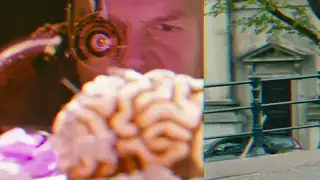
{"direction":"left","strength":0.4}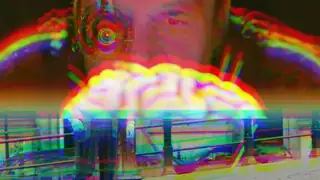
{"direction":"up","strength":2}
{"direction":"down","strength":1.4}Spec and test details
- Engine
- HyperFrames 0.8.10, GSAP 3.14.2 (local copy)
- Length and frame rate
- 5 seconds at 24 fps, rendered at 1920x1080
- Video files on this page
- H.264: 1920x1080 for Expand (4992.6 KB), 1280x720 in the page (2064.3 KB), 640x360 in galleries (395.6 KB), no audio
- Picture check
- The 1080p file scores VMAF 99.11 against our render master and keeps 95% of its edge detail (measured by us with FFmpeg libvmaf and OpenCV)
- Footage
- Barley looking at a glowing brain in a jar, warm (Tears of Steel, 0:58); young Thom walking on a canal bridge, Amsterdam street, daylight (Tears of Steel, 4:22)
- Tested in editors
- None yet
- Flash check
- Passed: at most 1 general and 0 red flashes in any second. automated approximation of WCAG 2.3.1 on a 96x54 grid, whole loop including the restart; not a certification.
- Licence
- Composition adapted by us from the HyperFrames registry (Apache-2.0); text fonts from Google Fonts under the SIL Open Font License.
- Last tested
- Nov 7, 2026
- Machine
- Laptop: AMD Ryzen 7 7735U (8 cores, 16 threads), 31 GB RAM, Windows 11 Home; CPU rendering
Technical details: render times and file sizes
- Render of the 5-second master: 66.6 s (2 render workers, on the laptop above).
- full.mp4: 4992.6 KB
- hero.mp4: 2064.3 KB
- hero.webp: 63.4 KB
- tile.mp4: 395.6 KB
- tile.webp: 21.7 KB
- real-edit.mp4: 1289.3 KB
- real-edit-full.mp4: 4391.8 KB
- real-edit.webp: 58.3 KB
- Variation "subtle": rendered in 70.2 s, 417.9 KB
- Variation "bold": rendered in 62.2 s, 423.8 KB
- Variation "down": rendered in 63.9 s, 416.2 KB
Credits
- Built from the HyperFrames registry component chromatic-aberration-wipe by HeyGen (Apache-2.0), adapted by us.
- Fonts from Google Fonts, under the SIL Open Font License.
- Footage: Tears of Steel, (c) Blender Foundation, mango.blender.org, licensed CC-BY 3.0. We cropped the shots to 16:9 and laid our graphics over them.
- Editor templates and other routes on this page belong to their creators, who are credited on each card.
Related effects and jobs
Page checked on Nov 4, 2026.