Effect #102 in our rendered series
Cinematic Zoom Transition
A creator cuts between two shots with a fast zoom-blur punch and speed lines.
Rendered by us at 1920x1080 over shots from Tears of Steel (Blender Foundation, CC-BY 3.0). Expand plays the full 1080p file.
Edit in Premiere, Resolve or After Effects? Jump to editor templates. Making many versions of the same video? Use the code route.
Make this effect with
Built and tested by us
Other ways, not tested by us
Use it in a real edit
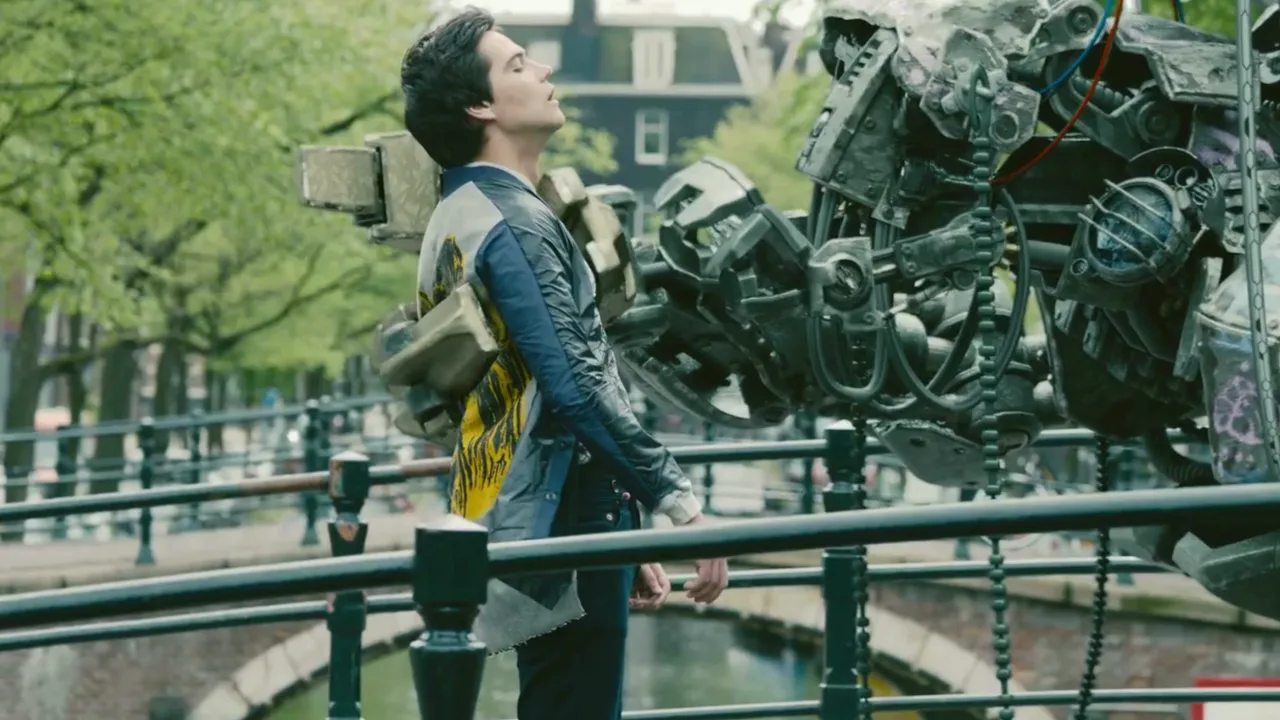
The same zoom punch from the soldier on the balcony to Thom by the canal. Nothing in the composition changed except the footage file.
The composition plays your clip as a muted <video> layer under the graphics (the file plate.mp4 in the code below), so you swap the footage by replacing that file and rendering again. To use the graphics in an editor instead, switch the background off and render a transparent MOV (an H.264 MP4 cannot carry transparency):
npx hyperframes render . -o overlay.mov --format mov --fps 24 --variables '{"plate":false}'The routes in full
With Claude Code: the prompt we used
Rendered and tested by us in HyperFrames 0.8.10 on Nov 14, 2026.
Make a 5 second cinematic zoom transition between two real shots. The first shot plays, then punches hard toward the camera: it scales up fast with a growing blur and a brightness boost while white speed lines streak out from the centre. At the peak, a short flash, and the second shot lands from an oversized, blurred state and settles to sharp. The punch takes about half a second. Make the zoom amount, the blur and the flash strength variables, and keep a switch that hides the footage.
What changed since this prompt: the demo on this page is our second version, 5 seconds long, rebuilt on 2 shots from Tears of Steel with the same animation idea. The full composition below is the one we rendered; its build log lists every change.
Built by Claude Code (Opus) from the HyperFrames registry block cinematic-zoom, then edited by us for real footage. Claude Code then checked the composition with hyperframes lint and hyperframes check before we rendered it.
What we had to correct (4 notes from the build log):
- cinematic-zoom is a shader radial blur. We approximated it with a fast scale-up plus CSS blur and brightness on the outgoing shot, the mirror move on the incoming shot, and a masked conic-gradient speed-line layer, all plain GSAP so it renders the same headless.
- The speed lines stand in for the radial streaks; there is no true per-pixel radial blur.
- v2 (14 Nov 2026): footage layers enlarged by 130 px each side so the blur does not bleed a white border at the frame edge during the punch; poster moved from 2.3 s (full blur) to 2.9 s, a clean frame after the punch.
- v2 (14 Nov 2026): rendered with tr_street to tr_holo (real edit tr_soldier to tr_canal); flash checks pass.
With HyperFrames code
Rendered and tested by us in HyperFrames 0.8.10 on Nov 14, 2026.
npx hyperframes add cinematic-zoom
npx hyperframes render . -o out.mp4 --fps 24
Settings you can change without rebuilding (pass them with --variables):
| Setting | Name | Type | Default |
|---|---|---|---|
| Zoom amount | zoom | number | 2.6 |
| Blur (px) | blur | number | 26 |
| Mid flash strength | flash | number | 0.5 |
| Show background | plate | boolean | true |
Our full composition (index.html, 4 KB)
<!doctype html>
<html lang="en" data-composition-variables='[{"id": "zoom", "type": "number", "label": "Zoom amount", "default": 2.6, "min": 1.4, "max": 5}, {"id": "blur", "type": "number", "label": "Blur (px)", "default": 26, "min": 0, "max": 60}, {"id": "flash", "type": "number", "label": "Mid flash strength", "default": 0.5, "min": 0, "max": 1}, {"id": "plate", "type": "boolean", "label": "Show background", "default": true}]'>
  <head>
    <meta charset="UTF-8" />
    <meta name="viewport" content="width=1920, height=1080" />
    <link href="https://fonts.googleapis.com/css2?family=Montserrat:wght@600;800&display=block" rel="stylesheet" />
    <script src="gsap.min.js"></script>
    <style>
      *, *::before, *::after { box-sizing: border-box; margin: 0; padding: 0; }
      html, body { width: 1920px; height: 1080px; overflow: hidden; background: transparent; }
      #root { position: relative; width: 100%; height: 100%; overflow: hidden; background: transparent; }
      .vid { position: absolute; left: 0; top: 0; width: 1920px; height: 1080px; object-fit: cover; }
      .mont { font-family: "Montserrat", sans-serif; font-weight: 800; }

      .scene { position: absolute; left: 0; top: 0; width: 1920px; height: 1080px; transform-origin: 50% 50%; will-change: transform, filter; }
      .scene .vid { left: -130px; top: -73px; width: 2180px; height: 1226px; }
      #lines { position: absolute; inset: -200px; background: repeating-conic-gradient(from 0deg at 50% 50%, rgba(255,255,255,0.65) 0deg 0.7deg, rgba(255,255,255,0) 0.7deg 3.4deg); -webkit-mask-image: radial-gradient(circle at 50% 50%, transparent 14%, #000 72%); mask-image: radial-gradient(circle at 50% 50%, transparent 14%, #000 72%); mix-blend-mode: screen; opacity: 0; }
      #fl { position: absolute; inset: 0; background: #fff; opacity: 0; }

    </style>
  </head>
  <body>
    <div id="root" data-composition-id="main" data-start="0" data-duration="5" data-fps="24" data-width="1920" data-height="1080">
      <div class="scene" id="A"><video id="v1" class="plate vid " src="plate_a.mp4" muted playsinline data-start="0" data-duration="2.9"></video></div>
      <div class="scene" id="B"><video id="v2" class="plate vid " src="plate_b.mp4" muted playsinline data-start="2.1" data-duration="2.9"></video></div>
      <div id="lines"></div><div id="fl"></div>
    </div>
    <script>
      window.__timelines = window.__timelines || {};
      (function () {
        const v = window.__hyperframes.getVariables();
        const tl = gsap.timeline({ paused: true });
        if (!v.plate) document.querySelectorAll(".plate").forEach((e) => (e.style.display = "none"));
        const $ = (s) => document.querySelector(s);

        const T = 2.1, D = 0.5, Z = v.zoom, Bl = v.blur;
        tl.fromTo("#A", { scale: 1, filter: "blur(0px) brightness(1)" }, { scale: Z, filter: "blur(" + Bl + "px) brightness(1.7)", duration: D * 0.55, ease: "power3.in", immediateRender: false }, T);
        tl.set("#A", { opacity: 0 }, T + D * 0.55);
        tl.fromTo("#B", { scale: 1 / Z * 1.4, filter: "blur(" + Bl + "px) brightness(1.7)" }, { scale: 1, filter: "blur(0px) brightness(1)", duration: D * 0.75, ease: "power3.out" }, T + D * 0.4);
        tl.fromTo("#B", { opacity: 0 }, { opacity: 1, duration: 0.08, ease: "none" }, T + D * 0.5);
        tl.fromTo("#lines", { opacity: 0, scale: 0.8 }, { opacity: 0.8, scale: 1.3, duration: D * 0.5, ease: "power2.in" }, T);
        tl.to("#lines", { opacity: 0, scale: 1.6, duration: D * 0.6, ease: "power2.out" }, T + D * 0.5);
        tl.fromTo("#fl", { opacity: 0 }, { opacity: v.flash, duration: 0.06 }, T + D * 0.5);
        tl.to("#fl", { opacity: 0, duration: 0.25, ease: "power2.out" }, T + D * 0.5 + 0.06);

        tl.to({}, { duration: 5 }, 0);
        window.__timelines["main"] = tl;
      })();
    </script>
  </body>
</html>
With Remotion
We have not built this effect in Remotion. If you use it, read its licence first: Individuals (personal or commercial use), organisations or teams with a total headcount of 3 or less, non-profits, and anyone evaluating Remotion before commercial use. A company does not qualify merely because it is unprofitable. Everyone not eligible for the Free License needs a Company License. Remotion licence FAQ, checked Nov 4, 2026.
In your editor: Premiere, Resolve, After Effects, CapCut
We have not reviewed an editor template for this effect yet.
Variations
The same composition rendered again with different settings. Nothing was rebuilt.

{"zoom":1.8,"blur":14,"flash":0.2}
{"zoom":4.2,"blur":46,"flash":0.9}
{"flash":0}Spec and test details
- Engine
- HyperFrames 0.8.10, GSAP 3.14.2 (local copy)
- Length and frame rate
- 5 seconds at 24 fps, rendered at 1920x1080
- Video files on this page
- H.264: 1920x1080 for Expand (5571 KB), 1280x720 in the page (2273.6 KB), 640x360 in galleries (435 KB), no audio
- Picture check
- The 1080p file scores VMAF 99.71 against our render master and keeps 92% of its edge detail (measured by us with FFmpeg libvmaf and OpenCV)
- Footage
- young Thom walking on a canal bridge, Amsterdam street, daylight (Tears of Steel, 4:22); scientist with glasses behind a neon hologram UI (Tears of Steel, 5:03)
- Tested in editors
- None yet
- Flash check
- Passed: at most 1 general and 0 red flashes in any second. automated approximation of WCAG 2.3.1 on a 96x54 grid, whole loop including the restart; not a certification.
- Licence
- Composition adapted by us from the HyperFrames registry (Apache-2.0); text fonts from Google Fonts under the SIL Open Font License.
- Last tested
- Nov 14, 2026
- Machine
- Laptop: AMD Ryzen 7 7735U (8 cores, 16 threads), 31 GB RAM, Windows 11 Home; CPU rendering
Technical details: render times and file sizes
- Render of the 5-second master: 35.4 s (2 render workers, on the laptop above).
- full.mp4: 5571 KB
- hero.mp4: 2273.6 KB
- hero.webp: 49 KB
- tile.mp4: 435 KB
- tile.webp: 17.8 KB
- real-edit.mp4: 2439.5 KB
- real-edit-full.mp4: 5223.1 KB
- real-edit.webp: 83.5 KB
- Variation "subtle": rendered in 38.8 s, 435.3 KB
- Variation "bold": rendered in 36.9 s, 433.2 KB
- Variation "clean": rendered in 35.2 s, 438.6 KB
Credits
- Built from the HyperFrames registry block cinematic-zoom by HeyGen (Apache-2.0), adapted by us.
- Fonts from Google Fonts, under the SIL Open Font License.
- Footage: Tears of Steel, (c) Blender Foundation, mango.blender.org, licensed CC-BY 3.0. We cropped the shots to 16:9 and laid our graphics over them.
- Editor templates and other routes on this page belong to their creators, who are credited on each card.
Related effects and jobs
Page checked on Nov 4, 2026.