Effect #080 in our rendered series
Cut the curve transition
A card accelerates off one side with blur and streaks, the scene swaps at peak speed, and a disc decelerates in from the other side.
Rendered by us at 1920x1080 over shots from Tears of Steel (Blender Foundation, CC-BY 3.0). Expand plays the full 1080p file.
Edit in Premiere, Resolve or After Effects? Jump to editor templates. Making many versions of the same video? Use the code route.
Make this effect with
Built and tested by us
Other ways, not tested by us
Use it in a real edit
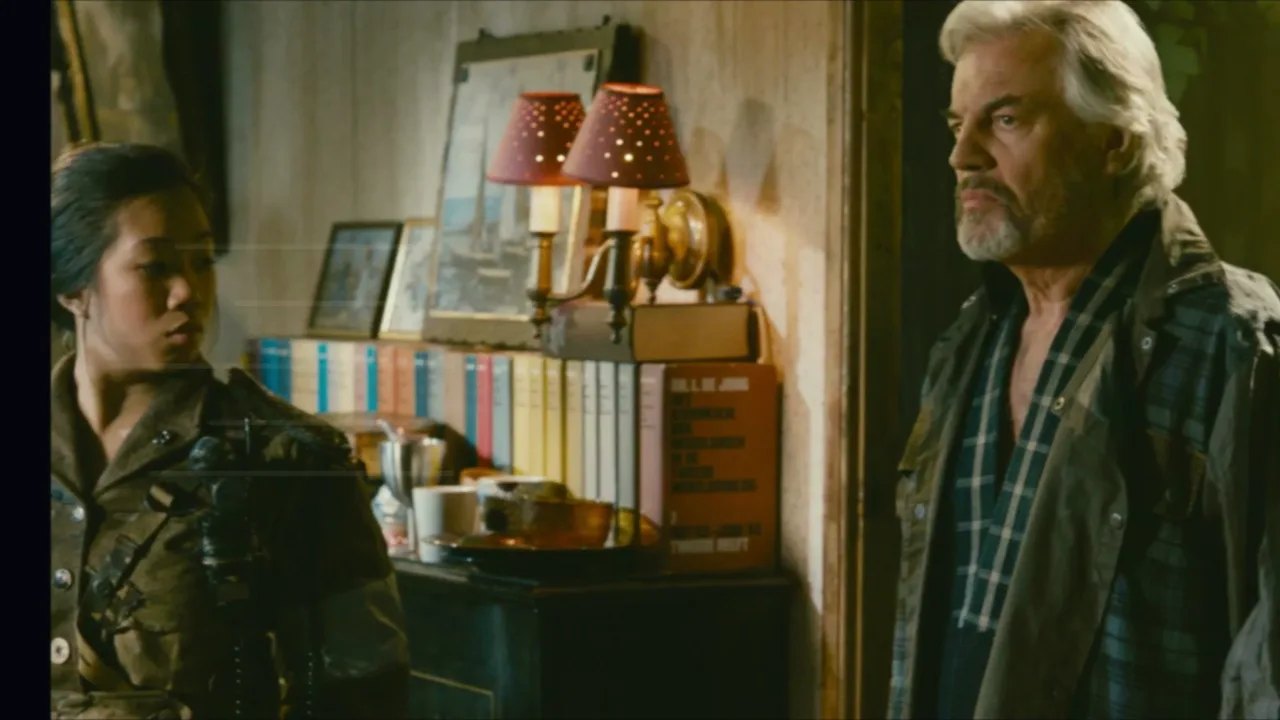
The same speed-ramped slide from the warm room to the skyline. Nothing in the composition changed except the footage file.
The composition plays your clip as a muted <video> layer under the graphics (the file plate.mp4 in the code below), so you swap the footage by replacing that file and rendering again. To use the graphics in an editor instead, switch the background off and render a transparent MOV (an H.264 MP4 cannot carry transparency):
npx hyperframes render . -o overlay.mov --format mov --fps 24 --variables '{"plate":false}'The routes in full
With Claude Code: the prompt we used
Rendered and tested by us in HyperFrames 0.8.10 on Nov 7, 2026.
Write a HyperFrames velocity-matched cut: an object accelerates off one side of the frame, the scene swaps at peak speed, and the next object decelerates in from the other side. Make the direction and the blur amount variables.
What changed since this prompt: the demo on this page is our second version, 5 seconds long, rebuilt on 2 shots from Tears of Steel with the same animation idea. The full composition below is the one we rendered; its build log lists every change.
Built by a Claude Code subagent (Sonnet) from the HyperFrames registry block cut-the-curve, HyperFrames 0.8.10. Claude Code then checked the composition with hyperframes lint and hyperframes check before we rendered it.
What we had to correct (13 notes from the build log):
- 6 Nov 2026, lint 1: 0 errors, 0 warnings.
- Adapted from cut-the-curve: kept the technique of power4.in out, hard swap at the seam, power4.out in, with matched blur at the seam. Rebuilt as a standalone composition with two full-frame objects (a card for scene A, a disc for scene B), a direction variable (left, right, up, down) and a blur variable (0 to 60 px).
- The travel distance is computed from the blur amount, so the object, its stretch and its blur are fully off the frame at the moment the background swaps. That makes the swap invisible and avoids needing an opacity match.
- Added: a 16 percent stretch along the travel axis at peak speed and five speed streaks that trail whichever object is moving. Streaks start at opacity 0 and use fromTo with immediateRender false.
- Second pass moves in the same direction (B leaves, A returns from the opposite side), so the loop closes on scene A at rest.
- The two backgrounds are dark and close in brightness, and the swap is a 0.1 s fade, so there is no flash.
- With the background off, only the objects and streaks remain.
- Decided against: a colour or opacity change at the seam (not needed once the object has left the frame), and a camera shake.
- lint 0 errors, 0 warnings. hyperframes check: "Check passed" (the only layout items are info lines about the shared background plate drifting past its frame, by design).
- Flash check (WCAG 2.3.1 approximation, whole loop): pass, 0 general and 0 red flashes per second.
- Four 1920 px frames looked at by eye across the loop: no clipped object, no text overlap, no stray mark, contrast fine at settled frames. No fault found, nothing changed.
- The disc leaves the frame at the right edge on purpose (that is the exit of the cut); it is not clipped at any settled moment.
- v2 (7 Nov 2026): real footage from Tears of Steel, plates tr_celia, tr_sniper. Whole-frame speed-ramped slide: A leaves with power4.in and stretch, B decelerates in (0.9 s total). A black stage replaces the old gradient (a first render showed white behind the gap).
With HyperFrames code
Rendered and tested by us in HyperFrames 0.8.10 on Nov 7, 2026.
npx hyperframes add cut-the-curve
npx hyperframes render . -o out.mp4 --fps 24
Settings you can change without rebuilding (pass them with --variables):
| Setting | Name | Type | Default |
|---|---|---|---|
| Travel direction | direction | enum | right |
| Motion blur (px) | blurPx | number | 24 |
| Show background | plate | boolean | true |
Our full composition (index.html, 7 KB)
<!doctype html>
<html lang="en" data-composition-variables='[{"id": "direction", "type": "enum", "label": "Travel direction", "default": "right", "options": [{"value": "left", "label": "Left"}, {"value": "right", "label": "Right"}, {"value": "up", "label": "Up"}, {"value": "down", "label": "Down"}]}, {"id": "blurPx", "type": "number", "label": "Motion blur (px)", "default": 24, "min": 0, "max": 60}, {"id": "plate", "type": "boolean", "label": "Show background", "default": true}]'>
  <head>
    <meta charset="UTF-8" />
    <meta name="viewport" content="width=1920, height=1080" />
    <link href="https://fonts.googleapis.com/css2?family=Inter:wght@700;800&display=block" rel="stylesheet" />
    <script src="gsap.min.js"></script>
    <style>
      *, *::before, *::after { box-sizing: border-box; margin: 0; padding: 0; }
      html, body { width: 1920px; height: 1080px; overflow: hidden; background: transparent; }
      #root { position: relative; width: 100%; height: 100%; overflow: hidden; background: transparent; }
      .vid { position: absolute; left:0; top:0; width:1920px; height:1080px; object-fit: cover; }
      .noplate .plate { display: none; }
      .streak { position: absolute; border-radius: 4px; background: #fff; opacity: 0; }
      .obj { position: absolute; inset: 0; }
      #stage { position: absolute; inset: 0; background: #06080d; overflow: hidden; }
    </style>
  </head>
  <body>
    <div id="root" data-composition-id="main" data-start="0" data-duration="5" data-fps="24" data-width="1920" data-height="1080">
      <div id="stage">
        <div class="obj" id="oA"><video class="plate vid" src="plate_a.mp4" muted playsinline data-start="0" data-duration="2.4"></video></div>
        <div class="obj" id="oB"><video class="plate vid" src="plate_b.mp4" muted playsinline data-start="2.3" data-duration="2.7"></video></div>
        <div id="streaks"></div>
      </div>
    </div>
    <script>
      window.__timelines = window.__timelines || {};
      (function () {
        const v = window.__hyperframes.getVariables();
        const tl = gsap.timeline({ paused: true });
        if (!v.plate) document.getElementById("root").classList.add("noplate");
        const W = 1920, H = 1080;
        function clamp(a, b, x) { return Math.max(a, Math.min(b, x)); }
        function hexRgb(h) {
          h = String(h == null ? "" : h).trim();
          if (/^#[0-9a-f]{3}$/i.test(h)) h = "#" + h[1] + h[1] + h[2] + h[2] + h[3] + h[3];
          if (!/^#[0-9a-f]{6}$/i.test(h)) return null;
          return [parseInt(h.slice(1, 3), 16), parseInt(h.slice(3, 5), 16), parseInt(h.slice(5, 7), 16)];
        }
        function lin(c) { c /= 255; return c <= 0.03928 ? c / 12.92 : Math.pow((c + 0.055) / 1.055, 2.4); }
        function lum(c) { return 0.2126 * lin(c[0]) + 0.7152 * lin(c[1]) + 0.0722 * lin(c[2]); }
        function cr(a, b) { const x = lum(a), y = lum(b); return (Math.max(x, y) + 0.05) / (Math.min(x, y) + 0.05); }
        function mixc(a, b, t) { return [Math.round(a[0] + (b[0] - a[0]) * t), Math.round(a[1] + (b[1] - a[1]) * t), Math.round(a[2] + (b[2] - a[2]) * t)]; }
        function css(c) { return "rgb(" + c[0] + "," + c[1] + "," + c[2] + ")"; }
        function okColor(h, def) { return hexRgb(h) || hexRgb(def); }
        // darken a colour until white text on it reaches at least 4.8:1
        function darkFor(c) { let t = 0, d = c; while (cr(d, [255, 255, 255]) < 4.8 && t < 1) { t += 0.04; d = mixc(c, [0, 0, 0], t); } return d; }

        const DIRS = { left: [-1, 0], right: [1, 0], up: [0, -1], down: [0, 1] };
        const dirName = DIRS[v.direction] ? v.direction : "right";
        const dx = DIRS[dirName][0], dy = DIRS[dirName][1];
        const horiz = dx !== 0, dsign = dx + dy;
        let blur = Number(v.blurPx); if (!isFinite(blur)) blur = 24; blur = clamp(0, 60, blur);
        const dist = (horiz ? W : H) / 2 + 420 + blur * 3;   // far enough that object, stretch and blur are fully off frame
        const sp = horiz ? "scaleX" : "scaleY", axis = horiz ? "x" : "y", STR = 1.1;
        const E = 0.4, N = 0.5;                              // exit and entry durations
        const B0 = "blur(0px)", B1 = "blur(" + blur + "px)";
        gsap.set("#oA", { x: 0, y: 0, filter: B0, scaleX: 1, scaleY: 1 });
        gsap.set("#oB", { x: -dx * dist, y: -dy * dist, filter: B1, scaleX: 1, scaleY: 1 });
        gsap.set("#oB", { [sp]: STR });

        // speed streaks that trail whichever object is moving
        const fr = [-1, -0.5, 0.05, 0.55, 1], lens = [420, 300, 520, 340, 460], perpMax = horiz ? 170 : 240;
        const streaks = [];
        const box = document.getElementById("streaks");
        for (let i = 0; i < fr.length; i++) {
          const el = document.createElement("div"); el.className = "streak";
          const th = 8, len = lens[i], perp = fr[i] * perpMax;
          if (horiz) { el.style.width = len + "px"; el.style.height = th + "px"; el.style.left = (W / 2 - len / 2) + "px"; el.style.top = (H / 2 - th / 2 + perp) + "px"; }
          else { el.style.width = th + "px"; el.style.height = len + "px"; el.style.left = (W / 2 - th / 2 + perp) + "px"; el.style.top = (H / 2 - len / 2) + "px"; }
          box.appendChild(el);
          const lead = (horiz ? 360 : 270) + len / 2 + (i % 2) * 30;
          gsap.set(el, { [axis]: dsign * (0 - lead), opacity: 0 });
          streaks.push({ el: el, lead: lead });
        }

        function pass(outEl, inEl, t0) {
          const cut = t0 + E;
          tl.fromTo(outEl, { x: 0, y: 0, filter: B0, [sp]: 1 }, { x: dx * dist, y: dy * dist, filter: B1, [sp]: STR, duration: E, ease: "power4.in", immediateRender: false }, t0);
          tl.fromTo(inEl, { x: -dx * dist, y: -dy * dist, filter: B1, [sp]: STR }, { x: 0, y: 0, filter: B0, [sp]: 1, duration: N, ease: "power4.out", immediateRender: false }, cut);
          streaks.forEach(function (s) {
            tl.fromTo(s.el, { [axis]: dsign * (0 - s.lead) }, { [axis]: dsign * (dist - s.lead), duration: E, ease: "power4.in", immediateRender: false }, t0);
            tl.fromTo(s.el, { opacity: 0 }, { opacity: 0.35, duration: E, ease: "power2.in", immediateRender: false }, t0);
            tl.fromTo(s.el, { [axis]: dsign * (-dist - s.lead) }, { [axis]: dsign * (0 - s.lead), duration: N, ease: "power4.out", immediateRender: false }, cut);
            tl.fromTo(s.el, { opacity: 0.35 }, { opacity: 0, duration: N, ease: "power2.out", immediateRender: false }, cut);
          });
        }
        pass("#oA", "#oB", 1.9);   // A leaves at its peak speed, the scene swaps, B decelerates in
        tl.to({}, { duration: 5 }, 0);

        window.__timelines["main"] = tl;
      })();
    </script>
  </body>
</html>
With Remotion
We have not built this effect in Remotion. If you use it, read its licence first: Individuals (personal or commercial use), organisations or teams with a total headcount of 3 or less, non-profits, and anyone evaluating Remotion before commercial use. A company does not qualify merely because it is unprofitable. Everyone not eligible for the Free License needs a Company License. Remotion licence FAQ, checked Nov 4, 2026.
In your editor: Premiere, Resolve, After Effects, CapCut
We have not reviewed an editor template for this effect yet.
Variations
The same composition rendered again with different settings. Nothing was rebuilt.

{"direction":"right","blurPx":6}
{"direction":"left","blurPx":48}
{"direction":"up","blurPx":30}Spec and test details
- Engine
- HyperFrames 0.8.10, GSAP 3.14.2 (local copy)
- Length and frame rate
- 5 seconds at 24 fps, rendered at 1920x1080
- Video files on this page
- H.264: 1920x1080 for Expand (4554 KB), 1280x720 in the page (1344.2 KB), 640x360 in galleries (285.9 KB), no audio
- Picture check
- The 1080p file scores VMAF 98.38 against our render master and keeps 101% of its edge detail (measured by us with FFmpeg libvmaf and OpenCV)
- Footage
- Thom and Celia in the street, a robot hand at frame edge, daylight (Tears of Steel, 5:56); a soldier on a balcony drinking from a carton, rifle in foreground, cool blue (Tears of Steel, 2:26)
- Tested in editors
- None yet
- Flash check
- Passed: at most 1 general and 0 red flashes in any second. automated approximation of WCAG 2.3.1 on a 96x54 grid, whole loop including the restart; not a certification.
- Licence
- Composition adapted by us from the HyperFrames registry (Apache-2.0); text fonts from Google Fonts under the SIL Open Font License.
- Last tested
- Nov 7, 2026
- Machine
- Laptop: AMD Ryzen 7 7735U (8 cores, 16 threads), 31 GB RAM, Windows 11 Home; CPU rendering
Technical details: render times and file sizes
- Render of the 5-second master: 69.9 s (2 render workers, on the laptop above).
- full.mp4: 4554 KB
- hero.mp4: 1344.2 KB
- hero.webp: 47.1 KB
- tile.mp4: 285.9 KB
- tile.webp: 17.3 KB
- real-edit.mp4: 1332.9 KB
- real-edit-full.mp4: 4973.8 KB
- real-edit.webp: 44.7 KB
- Variation "subtle": rendered in 61.2 s, 283 KB
- Variation "bold": rendered in 55.4 s, 285.7 KB
- Variation "vertical": rendered in 57.3 s, 295.4 KB
Credits
- Built from the HyperFrames registry component cut-the-curve by HeyGen (Apache-2.0), adapted by us.
- Fonts from Google Fonts, under the SIL Open Font License.
- Footage: Tears of Steel, (c) Blender Foundation, mango.blender.org, licensed CC-BY 3.0. We cropped the shots to 16:9 and laid our graphics over them.
- Editor templates and other routes on this page belong to their creators, who are credited on each card.
Related effects and jobs
Page checked on Nov 4, 2026.